
The short answer: Interior designers charge in a few common ways: hourly, a flat fee, a percentage of the project cost, or a hybrid of these. National cost guides put typical hourly rates at roughly $100 to $500 an hour and room-based flat fees at roughly $1,500 to $4,900 per room. What you’ll pay depends on the scope, the services included, and how the designer handles product purchasing.
Design fees are one of the least transparent parts of a home project, and that’s mostly because there’s no single standard. Here is how each fee model works, what pushes cost up or down, and how to compare proposals fairly.
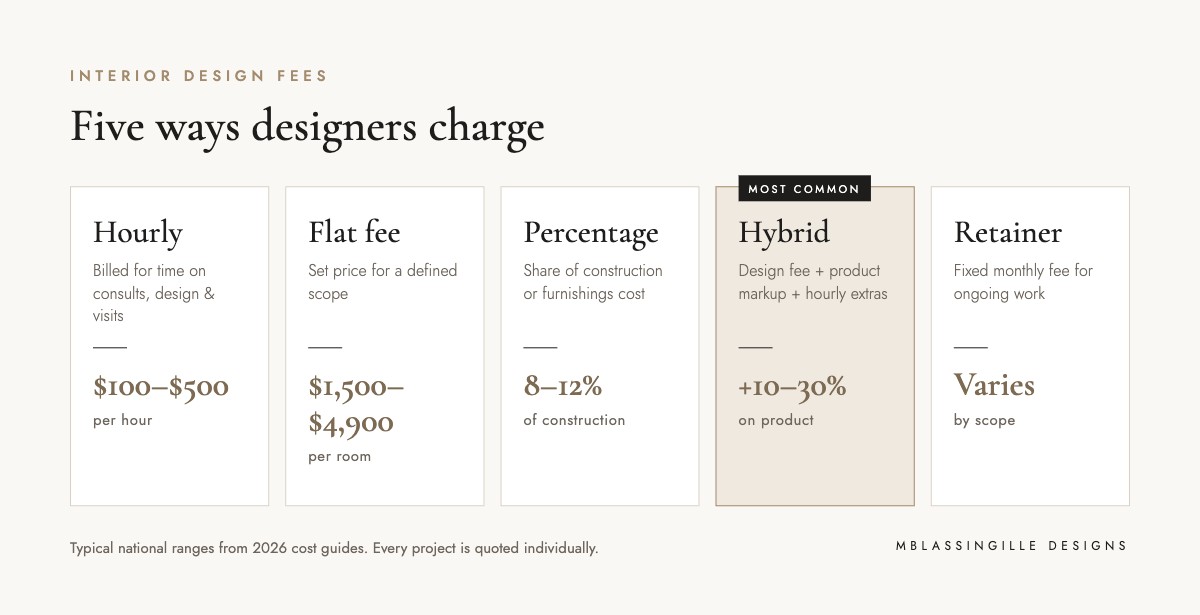
The 5 Common Ways Interior Designers Charge
| Fee model | How it works | Typical range (national) |
|---|---|---|
| Hourly | Billed for time spent on consultations, design, and site visits | About $100 to $500 per hour |
| Flat fee or package | A set price for a defined scope, per room or per project | About $1,500 to $4,900 per room, or about $9 to $17 per sq. ft. |
| Percentage | A percentage of construction cost and/or the furnishings budget | About 8% to 12% of construction, or 10% to 40% of furnishings |
| Hybrid (most common) | A design fee plus a markup on furnishings, with hourly billing for extra visits | Design fee plus about 10% to 30% on product |
| Monthly retainer | A fixed monthly fee for ongoing work, common with builders and repeat clients | Varies by scope |
Ranges reflect 2026 national cost guides and are for general comparison only. Every project is quoted individually.
Hourly
Hourly billing is simple and flexible, which makes it a good fit for consultations, a second opinion on selections, or a small scope. The tradeoff is that the total isn’t known up front, so ask for an estimate of hours.
Flat Fee or Package
A flat fee gives you cost certainty for a clearly defined scope. Make sure the proposal spells out what’s included, such as the number of revisions, site visits, and selections meetings, and what’s billed as extra.
Percentage of Project Cost
Percentage fees scale with the size of the project and are common on large remodels and new construction. Ask exactly what the percentage applies to: construction, furnishings, or both.
Hybrid
Most independent designers combine models, such as a flat design fee plus hourly billing for extra site visits and a markup on furnishings they purchase for you. Hybrids can be very fair. Just make sure every piece is written down.
Monthly Retainer
Retainers suit ongoing relationships, like a builder who needs selections help on several homes a year or a homeowner with a long, phased renovation.
How Trade Pricing Works
Designers can often buy furniture, lighting, and fixtures through trade showrooms and manufacturers at prices below retail. Some pass part of that savings on to clients, and some charge a markup over their trade cost to cover sourcing, ordering, tracking, receiving, and resolving damaged or incorrect items. Neither approach is wrong, but it should be clear. A good proposal tells you how product pricing works before you buy anything.
What Makes a Design Project Cost More (or Less)
- Scope: a powder room refresh and a whole-home renovation are very different jobs.
- Services included: a consultation costs less than design only, and design only costs less than design plus selections.
- Number of decisions: custom cabinetry, specialty tile layouts, and built-ins all take more design time.
- Project type: new construction, remodels, and high-rise condos each carry different coordination needs.
- Revisions and pace: major changes after selections are final add time, and so do long gaps between decisions.
For a breakdown of what each service includes, see what an interior designer actually does. To see whether full-service design or consulting fits your budget, read full-service designer vs. design consultant.
How to Budget for a Design Project
It helps to think in three separate buckets:
- Design fee: what you pay the designer for their time and expertise
- Construction: what your contractor charges for labor and materials
- Products and furnishings: fixtures, lighting, furniture, rugs, and decor
Sharing a realistic budget for all three up front lets your designer point your money where it matters most. That might be a better countertop in the kitchen everyone uses, with savings found in a guest bath. A designer also helps you avoid the most expensive mistake of all, which is buying the wrong things and replacing them.
How to Compare Design Proposals
- Is the scope of services clearly listed?
- How many site visits and revisions are included?
- How are product purchases priced, and is there a markup?
- What triggers additional fees?
- Are consultations billed hourly or by session?
- What’s the payment schedule?
A lower fee with less included can cost more in the end. Compare what each designer will actually do for you, not just the number on the page. Wondering what the process looks like once you sign? Here’s how to work with an interior designer in Dallas.
Interior Designer Cost: FAQs
How much does an interior designer cost per hour?
National cost guides for 2026 put typical interior designer hourly rates at about $100 to $500 per hour, depending on experience, market, and scope.
How much does an interior designer charge per room?
Flat-fee pricing per room typically runs about $1,500 to $4,900 in national cost guides, depending on the room type and the level of service. Kitchens and baths usually cost more than bedrooms or living areas.
What percentage do interior designers charge?
When designers charge a percentage, it’s commonly about 8% to 12% of construction cost or 10% to 40% of the furnishings budget, according to national cost guides. Always confirm what the percentage applies to.
Do interior designers mark up furniture?
Many do. Designers often buy at trade prices and either pass some savings on or charge a markup to cover sourcing, ordering, and handling. A good proposal explains product pricing clearly before anything is purchased.
Is hiring an interior designer worth the cost?
For remodels and new builds, often yes. A designer helps avoid costly layout mistakes, wrong orders, and rework, and keeps selections on schedule. Those savings can offset a meaningful part of the design fee.
Get a Clear Proposal for Your Project
MBlassingille Designs provides interior design, selections, and consulting for remodels and new construction in Dallas. Contact us for a written proposal tailored to your scope.
Leave a Reply